Wedgeheads
I think we can now say Tiltshift has representation of all the major eras of pinball machines.
- Dungeons & Dragons and Jurassic Park as the present day modern pinball machine.
- Medieval Madness and Star Trek are from the Dot Matrix Display (DMD) era.
- Meteor and Fireball II are early solid state machines.
- And the most recent additions, Volley and Spin Out are Electromechanical pinball machines.
Electromechanical
What is an electromechanical pinball machine?
The shortest explanation is that there is no computer chips inside it. All of the scoring, changing which lights are on, remembering how many credits are paid for, and more is done purely through switches, relays, and steppers.
Opening one of these machines is fascinating. What would be trivial in computer code translates to physical devices where you can observe their current state from the outside and watch as it changes when a switch is pressed. Let’s look at a couple of the components that make these machines possible.
Switches
All pinball machines have switches, but in a modern machine almost all of them have changed from leaf switches to microswitches.
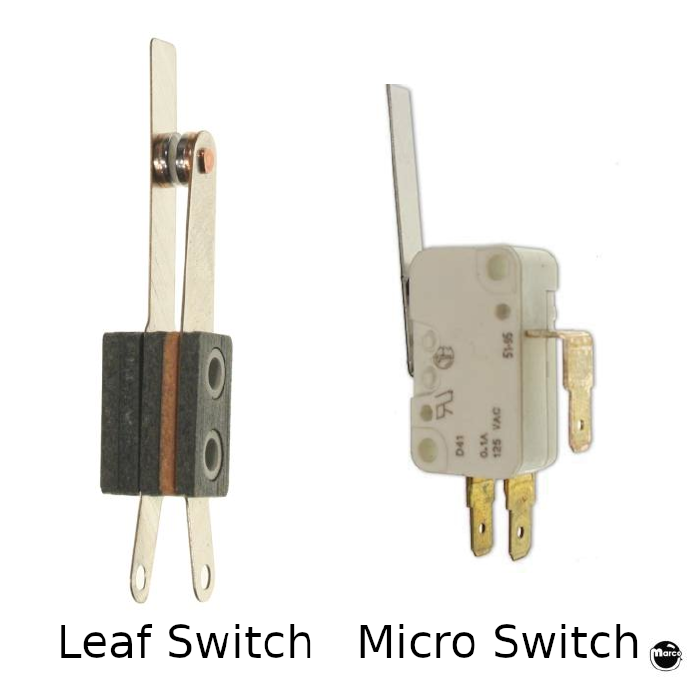
In a leaf switch, two metal strips are held slightly apart from each other, and the longer of the two strips can be moved (for example, hitting a target, or rolling over a lane) to close or open the switch.
A microswitch performs the same function, but the switch contacts are encased in a protective housing. You can no longer see exactly whether the switch is open or closed, but in exchange you also don’t need to manually clean and adjust them as much.
On an electromechanical pinball machine, a huge part of the regular maintenance is cleaning, adjusting, and replacing leaf switches. If something is not working, it’s almost certainly a bad switch somewhere, you just have to find which one!
Relays
What do you get when you take a bunch of switches and make it so you can open or close them with another switch? A relay!
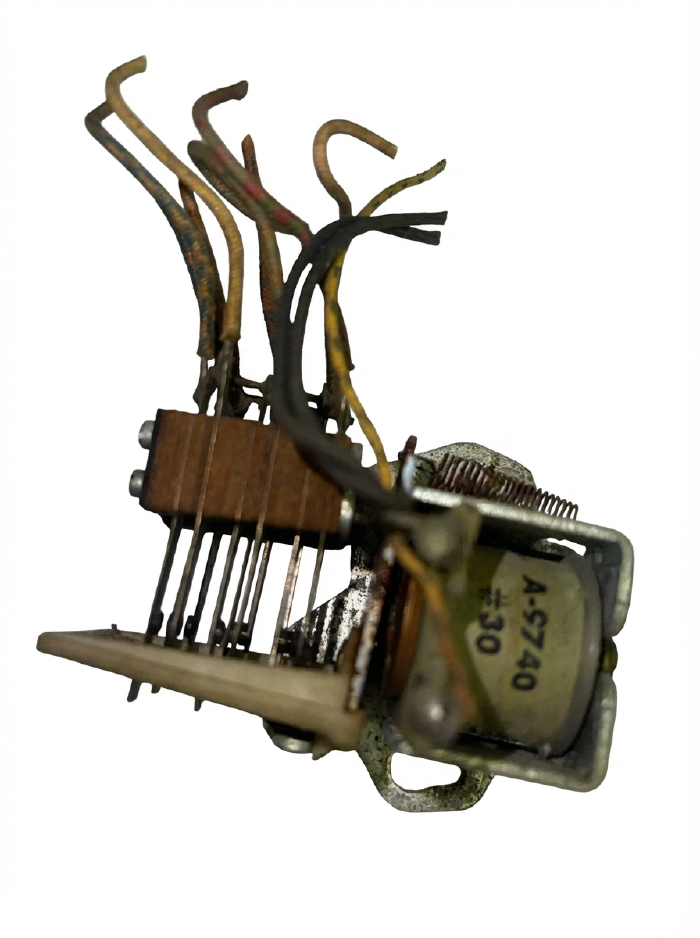
There are three main components to a relay. The coil of wire on the right, which when energized turns into a magnet, the stack of leaf switches, and a frame that ties the two together. Energizing the coil attracts a metal plate towards the magnet, shifting the frame, and opening or closing the stack of switches.
Using a relay you can have one action control another. For example, the switch behind the rubber band on the slingshots will energize a relay which then causes the slingshot to fire and repel the ball away.
An electromechanical pinball machine can have dozens or possibly even hundreds of these, depending on how complex the rule set is.
Steppers
The last big component (at least that I’m going to cover) that makes these machines work is a stepper. Steppers are ratcheting wheels which can be moved one step at a time. Common examples of where these are used are the score reels, the credits counter, the ball in play counter, or the rototarget in Spin Out.
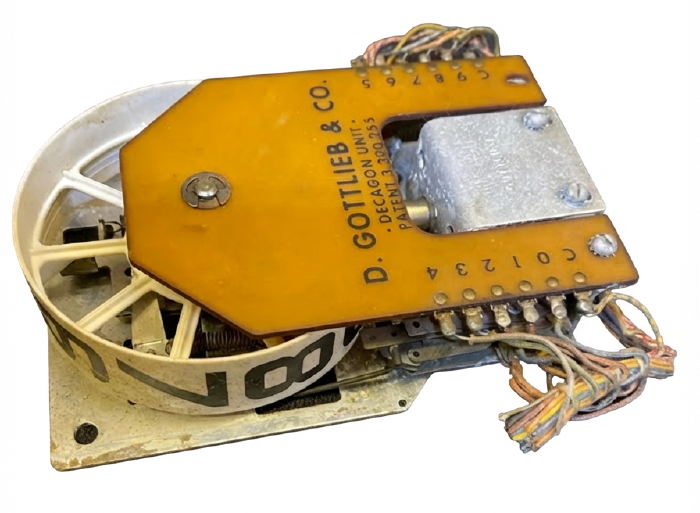
I won’t dive too far into these units, but this is what a score reel looks like behind the facade. The score reel itself is what actually keeps track of your score - it’s not just a display for a value stored elsewhere. Every time you hear a chime ring, one of these score reels steps up a number. If the reel was sitting on “9”, it also tells the adjacent reel to step up one.
I’m really just getting started learning about these machines, but they are so fascinating. I can’t even begin to imagine having the skills necessary to design the circuitry to make them work the way they do.
The New Machines
We got pretty deep in the weeds in that last section. I want to end with a tiny bit of information about the two new machines you’ll see in Tiltshift.
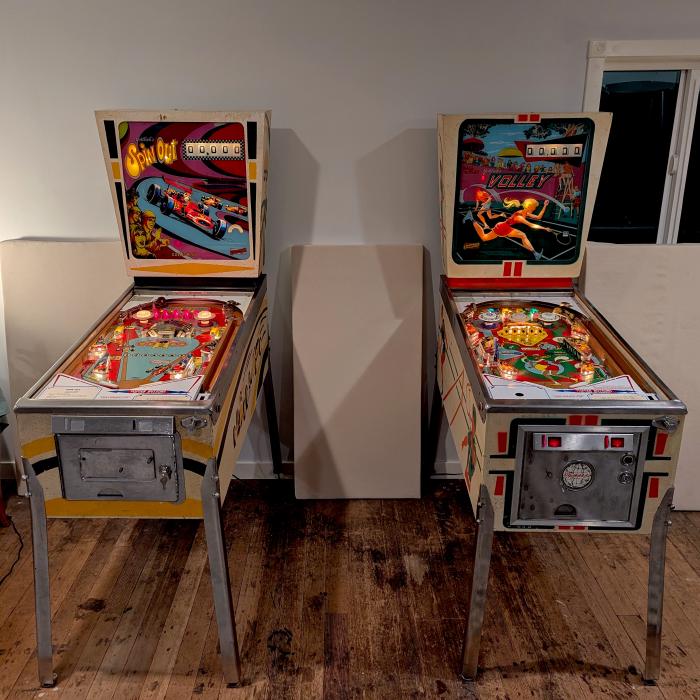
Spin Out and Volley are two “wedgehead” pinball machines from Gottlieb in 1975 and 1976. One has tons of drop targets, the other has a really neat spinning target, and they’re both surprisingly fun for how simple they are.
I’ll write up more about these machines, and wedgeheads more broadly in a future post, but in the meantime you’ll just have to come by this Tuesday and try them out!
If hearing a bit about electromechanical machines has piqued your interest, let me know and I’d be happy to go more in-depth!